

 2020-12-04
 287
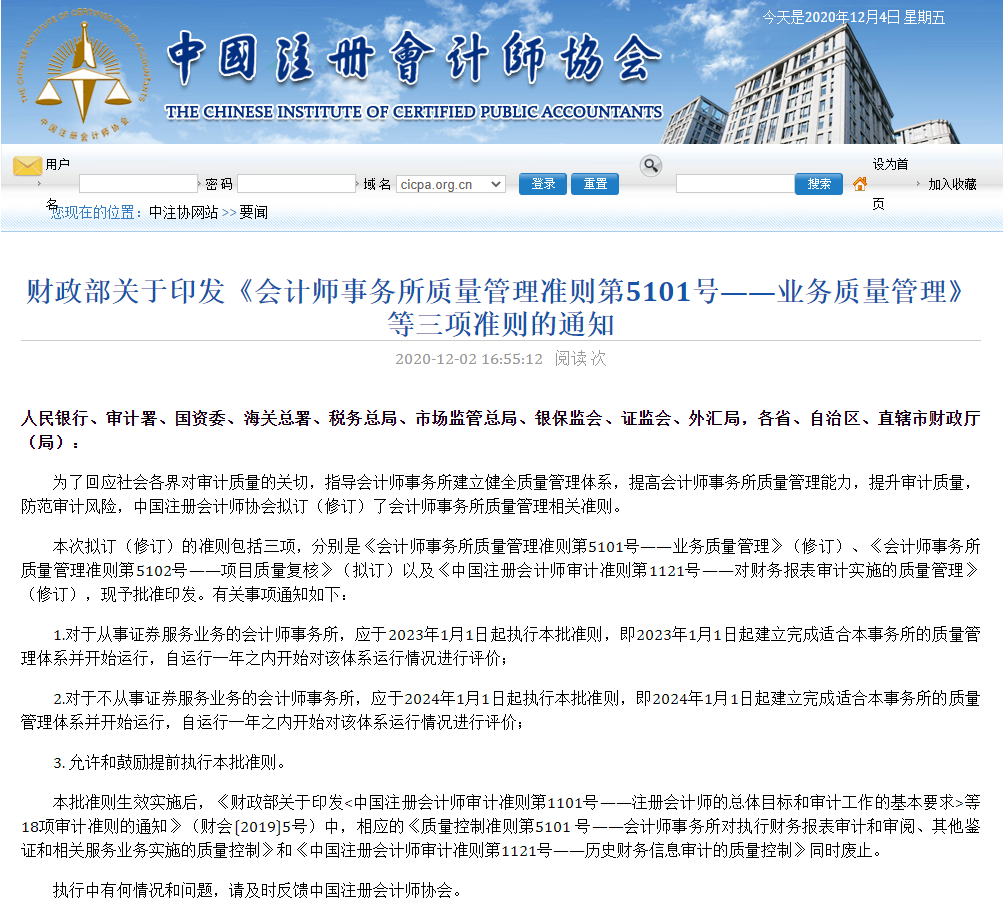
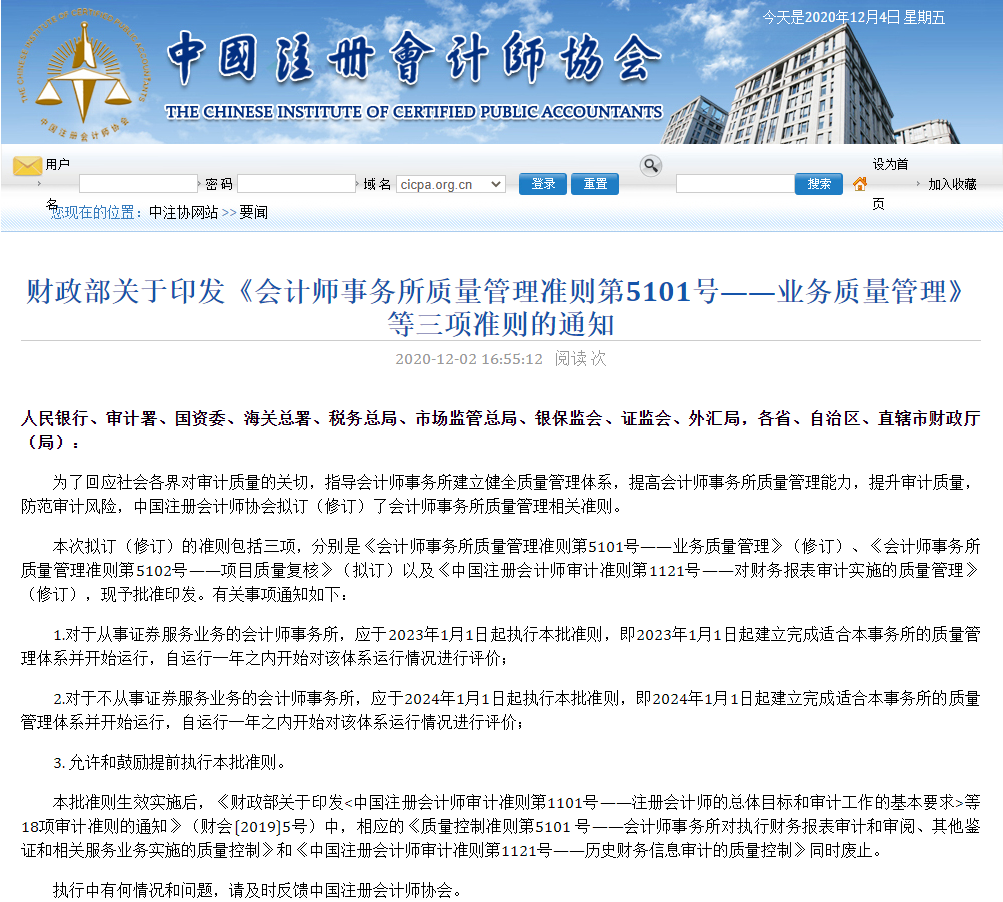
On November 19, 2020, the Ministry of Finance approved and issued three Chinese Certified Public Accountants' professional standards, including the "Quality Management Standard for Accounting Firms No. 5101 – Quality Management of Engagements" (hereinafter collectively referred to as the quality management standards).
Providing high-quality audit services is the lifeline of the CPA profession and the foundation for the survival, development, and market reputation of accounting firms. In response to the concerns of all sectors of society, including audit industry regulators, about audit quality, and to meet the new requirements and challenges posed by economic, social, and information technology developments for the management of accounting firms, and to enhance quality management capabilities, the Chinese Institute of Certified Public Accountants, addressing the prominent issues in quality management of accounting firms and drawing on the latest achievements of international quality management standards, drafted (revised) the quality management standards, which were submitted to the Ministry of Finance for approval and issuance.
The drafting (revision) of the quality management standards follows the following general principles and approaches:
First, adhere to the principle of safeguarding the public interest as the purpose. The quality management standards emphasize, overall, that accounting firms should serve the public interest through the consistent performance of high‑quality engagements, and that the purpose of the quality management system is to support the firm in consistently performing high‑quality engagements. The design, implementation, and operation of the quality management system provide a good tool for accounting firms to safeguard the public interest, and if firms implement the requirements of the quality management standards in place, they can effectively achieve the goal of safeguarding the public interest.
Second, adapt to the actual situation in China. The quality management standards pay special attention to combining the advanced achievements of international standards with the practice of the CPA profession in China, and propose effective solutions to the prominent problems existing in the quality management of Chinese accounting firms. For example, in response to the prominent problems of "integration" in some Chinese accounting firms, the quality management standards explicitly require that accounting firms should establish and strictly implement a sound integrated management mechanism to achieve unified management in five aspects: personnel, finance, business, technical standards, and information management, and this should not be an exception for merged branches (or divisions). For another example, in response to the problem of partner rotation being "perfunctory", the quality management standards explicitly require that accounting firms should establish and improve partner rotation mechanisms, clarify rotation requirements, ensure substantive rotation, and monitor rotation status in real time through methods such as establishing partner service year lists.
Third, adhere to the organic combination of principles and rules. The quality management standards first make principled provisions on the objectives, overall approach, and constituent elements of the quality management system of accounting firms, providing a thinking framework for the design, implementation, and operation of the quality management system. On this basis, they also make detailed provisions on specific aspects to provide specific guidance for accounting firms and CPAs in actual implementation. For example, in terms of firm governance and leadership, they not only prescribe the principles for setting up leadership structures but also provide examples of specific role responsibilities. Similarly, in terms of the qualification requirements for engagement quality reviewers, they not only prescribe principles such as professional competence, compliance with professional ethics and laws and regulations, but also specify the conditions that engagement quality reviewers should meet and the specific content of the review.
Fourth, maintain continuous and comprehensive dynamic convergence with international standards. The quality management standards cover all the requirements and content of the international quality management standards, and the vast majority of clauses are consistent with international standards. Although some clauses have minor differences from international standards, they are all specific applications of the principles in international standards to the Chinese context, which helps to combine the spirit of international standards with the specific practice of China's CPA profession.
The quality management standards specifically include three items: "Quality Management Standard for Accounting Firms No. 5101 – Quality Management of Engagements", "Quality Management Standard for Accounting Firms No. 5102 – Engagement Quality Review", and "China Standard on Auditing for Certified Public Accountants No. 1121 – Quality Management for Audits of Financial Statements".
"Quality Management Standard for Accounting Firms No. 5101 – Quality Management of Engagements" regulates how the quality of engagements is managed at the overall accounting firm level. This standard requires firms to adopt a new risk‑based approach to quality management, apply internal control theory, establish, improve, and effectively operate a firm‑wide unified quality management system, and specifies in detail the specific content of the system and the specific responsibilities of firm leadership and related personnel.
An independent review of important engagements by a partner not involved in the engagement is a powerful measure of quality management in a firm, and this independent review is called engagement quality review. "Quality Management Standard for Accounting Firms No. 5102 – Engagement Quality Review" provides detailed provisions on this. This standard clarifies the objectives and positioning of engagement quality review, sets higher requirements for the professional skills, authority, objectivity, etc., of engagement quality reviewers, and also makes detailed provisions on the specific review work and working paper requirements for engagement quality reviewers.
"China Standard on Auditing for Certified Public Accountants No. 1121 – Quality Management for Audits of Financial Statements" regulates how the quality of financial statement audit engagements is managed at the engagement team level. This standard emphasizes and refines the responsibilities of the engagement partner in quality management of audit engagements, requiring that the engagement partner should be fully involved throughout the audit process and making detailed provisions on directing, supervising, and reviewing the work of engagement team members.
To ensure the smooth and steady implementation of the quality management standards, a phased implementation approach is adopted. Specifically, accounting firms that engage in securities service business shall establish and begin operating a quality management system suitable for the firm from January 1, 2023, and shall begin to evaluate the operation of the system within one year of operation; accounting firms that do not engage in securities service business may postpone the above implementation date by one year, that is, they shall establish and begin operating a quality management system suitable for the firm from January 1, 2024, and shall begin to evaluate the operation of the system within one year of operation.
Source: Chinese Institute of Certified Public Accountants
 Official WeChat
 Official WeChat
