

 2026-06-15
 110
Valuation Asks for 40 Billion, Robot Capital Drama Reaches Crescendo
In October 2025, Zhiyuan Robotics, founded just over two years earlier, planned to launch its IPO in Hong Kong in 2026 with a target valuation of up to HK$40‑50 billion. As founder Deng Taihua put it, "You'd be embarrassed to mention a valuation below 10 billion," but Zhiyuan nearly tripled that benchmark in one go.
The collective IPO sprint of the "Six Dragons" has become one of the most intensive capital dramas in China's tech entrepreneurship history.
Among all the sprinters, Zhiyuan is the most unique: the shortest history, the fastest to exceed 1 billion in revenue, and the highest valuation claim. Behind it are two alumni of the University of Electronic Science and Technology — Deng Taihua, former Vice President of Huawei, and "Zhi Hui Jun," the "Huawei Genius Youth" — a dual‑core resonance.
I
"Veteran" Deng Taihua: From
Huawei VP to Zhiyuan's Operator
(I) Over Two Decades at Huawei
Before founding Zhiyuan Robotics, Deng Taihua spent over 20 years at Huawei. Early on, he was in charge of Huawei's flagship wireless product line (communication base stations, 5G, etc.), and later served as Vice President of Huawei and President of the Computing Product Line, leading the construction of the Kunpeng and Ascend AI computing ecosystems.
According to public sources, Deng Taihua graduated from the University of Electronic Science and Technology with a degree in computer communications. From wireless to computing, from communication base stations to AI chips, his career trajectory traces a clear line of technological depth. This experience of "building an ecosystem from 0 to 1" laid the underlying logic for his strategic layout at Zhiyuan.
In November 2022, Deng Taihua still appeared publicly as Huawei Vice President and President of the Computing Product Line. By February 2023, Zhiyuan Robotics was established; in September of that year, the president of Huawei's Computing Product Line had been replaced by Zhang Xiwei. The veteran Huawei executive's transition to entrepreneurship likely occurred around that time.
(II) "The Man Behind Zhi Hui Jun" Steps Forward
For a long time after Zhiyuan was founded, Deng Taihua deliberately kept a low profile. The spotlight remained on "Zhi Hui Jun" (Peng Zhihui) — the top Bilibili creator with 2.836 million followers, known as the "Wild Iron Man," who became virtually synonymous with Zhiyuan Robotics.
But in fact, Deng Taihua is the true "chief architect" of Zhiyuan. According to the Science and Technology Innovation Board Daily, it was Deng who invited Zhi Hui Jun, then still working at Huawei, to start the venture together, giving birth to today's Zhiyuan Robotics. In other words, Zhi Hui Jun is the front‑facing "tech icon," while Deng Taihua is the behind‑the‑scenes "strategic helmsman."
In March 2025, the legal representative of Zhiyuan Robotics changed from Shu Yuanchun to Deng Taihua, and the low‑key Huawei veteran finally stepped into the spotlight. In August of the same year, Deng Taihua made his first public appearance at Zhiyuan's first Partner Conference, delivering a confident statement to the audience: "We can raise funds whenever we want," and even without any revenue, existing cash flow would sustain the company for three years.
He was not exaggerating. Zhiyuan has never lacked capital.
(III) Capital Footprint: 10 Rounds, 10‑Billion Valuation, All‑Star Shareholders
Since 2023, Zhiyuan has completed more than 10 funding rounds. After the Series A round in 2024, its valuation exceeded 7 billion yuan. In March 2025, Tencent led the Series B round, pushing the valuation to 15 billion yuan. In July of the same year, it received strategic investments from LG Electronics and Mirae Asset Group. By March 2026, its valuation reached $2.07 billion (about 14.7 billion yuan). If the IPO goes smoothly, the target valuation of HK$40‑50 billion (approx. RMB 36.3‑45.5 billion) would represent a valuation increase of over 2.4 times in just over two years.
A table of its financing history and valuation leaps makes the trajectory clear:
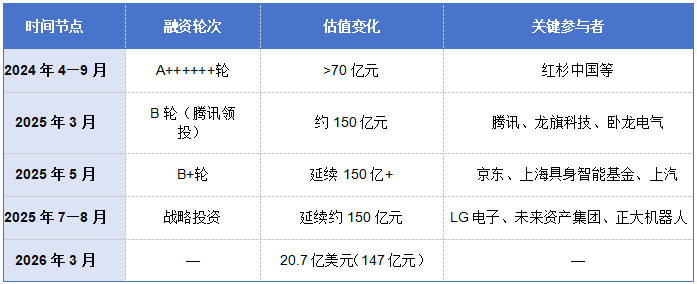
The shareholder list is a veritable "all‑star cast"—Tencent, JD.com, SAIC, BYD, Hillhouse, Sequoia, CDH, BlueRun, C Capital, Fosun, and others. According to New Fortune magazine: "In the past year and a half, Zhiyuan has raised over 2.7 billion yuan, with a valuation exceeding 15 billion yuan, and its shareholders include industry giants." Notably, the management team, including Deng Taihua and Zhi Hui Jun, still holds 50% equity, which was already worth over 7.5 billion yuan at the then valuation.
II
"New Star" Zhi Hui Jun: From B‑Station
Top Creator to 10‑Billion IPO Evangelist
(I) Huawei "Genius Youth" and B‑Station Top Creator
If Deng Taihua is the "helmsman" of Zhiyuan, then Peng Zhihui (Zhi Hui Jun) is its "flag."
Peng Zhihui, born in 1993 in Ji'an, Jiangxi, holds a bachelor's degree in biomedical engineering and a master's in information and communication systems from the University of Electronic Science and Technology. In 2020, he passed seven rounds of interviews and joined Huawei's "Genius Youth" program, working in the Ascend department on AI edge heterogeneous computing. At the end of 2022, he left Huawei to "pursue personal dreams"—the specific direction was unknown at the time.
But his other identity is far more widely known. His B‑Station account "Zhi Hui Jun" has 2.836 million followers and was named one of the Top 100 Creators of 2021. His hard‑core tech videos—self‑made gaming power banks, Iron Man robotic arms, autonomous bicycles—earned him the nickname "Wild Iron Man." A creator who could single‑handedly develop a humanoid robot arm was already signalling a clear direction: robotics entrepreneurship.
And indeed, in February 2023, Zhiyuan Robotics was established, with Peng Zhihui as co‑founder, president, and CTO.
(II) From Lab Showmanship to the "First Year of Deployment"
Zhi Hui Jun's value to Zhiyuan goes far beyond the brand effect of a "celebrity founder." On the technical side, he remains the core spokesperson and driver of Zhiyuan's technology roadmap.
In March 2026, Peng Zhihui, as Vice Chairman of the Ministry of Industry and Information Technology's Humanoid Robot and Embodied Intelligence Standardisation Technical Committee, delivered a keynote speech at the HEIS Annual Conference on the theme of the "First Year of Deployment" for embodied intelligence. He offered a precise industry judgment: "The entire embodied intelligence industry is still exploring together; no single company can provide the correct answer on its own. We need to jointly break through bottlenecks and do the right things at the right time."
Peng pointed out that from 2024 to early 2025, the industry focused on whether robots could walk naturally; by the second half of 2025, robots could perform high‑difficulty "wall‑climbing" manoeuvres. "Body flexibility has reached a practical stage. The next comparison is who can work better. Not only domestically, but also against leading overseas companies, to see who can truly land the deployment."
He proposed an engineering framework called "One Body, Three Intelligences" — one physical body layered with motion intelligence, interaction intelligence, and operational intelligence. This kind of systematic thinking reflects the depth of his technical insight. He also revealed that Zhiyuan has consolidated the joint designs of all product lines into eight standardised joint types, which are used across all products to meet joint requirements in all positions — a clear benefit of standardisation.
(III) The Dual‑Core Inside Zhiyuan: Who Steers, Who Evangelises?
The dual‑core structure finally surfaced in September 2025, when Zhiyuan officially disclosed its partner team. Deng Taihua is Founder, Chairman, and CEO; Peng Zhihui is Co‑Founder, President, and CTO. Also on the list are several executives with backgrounds from Huawei, Alibaba, and Silicon Valley labs — a "premium partner lineup" spanning the upstream and downstream industrial chain.
This dual‑core architecture is uncommon in tech startups. Usually, a high‑profile company finds it hard to accommodate two strong personalities — but Deng and Zhi Hui Jun have formed a complementary division of labour:
Deng Taihua focuses on capital, strategy, organisation, supply chain, and government relations, overseeing the big picture. He led key moves such as the acquisition of Shanghai New Materials, the formation of joint ventures with more than a dozen listed companies, and the establishment of an industry CVC.
Zhi Hui Jun focuses on technology roadmap, product definition, industry standards, and public communication. His progression from B‑Station creator to committee vice chairman shows that Zhiyuan is leveraging his influence to upgrade from "evangelist" to "participant in standard‑setting."
For the secondary market, the rarity of this dual‑core combo is self‑evident: it can articulate a credible tech narrative while withstanding capital scrutiny.
III
"358" Blueprint: 1 Billion in 3 Years,
10 Billion in 5 Years, 100 Billion in 8 Years
No one translates tech idealism into market‑ready language better than Deng Taihua.
On 17 April 2026, at the "2026 Zhiyuan Partner Conference" in Shanghai, Deng Taihua unveiled the "358 Blueprint." The core metrics are:
3 years (2025): Revenue exceeds RMB 1.05 billion, achieving entry‑level productivity and launching the first growth curve;
5 years (2027): Revenue exceeds RMB 10 billion+, achieving productivity from 0 to 1 and launching the second curve;
8 years (2030): Revenue exceeds RMB 100 billion+, achieving productivity scaling from 1 to N and welcoming the third curve.
Notably, these targets are grounded in solid performance. In its first year (2023), revenue was only RMB 300,000; in the second (2024), it reached over RMB 60 million; and by 2025, it had surpassed RMB 1.05 billion — nearly 20‑fold annual growth. Deng Taihua proudly noted that Zhiyuan is "the fastest robotics company in China to reach RMB 1 billion in revenue from inception."
Complementing this blueprint, Deng proposed the "XYZ Curve" theory: X corresponds to the early trial phase of robots "moving"; Y corresponds to the intelligence breakthrough driven by data flywheel; Z is the "ChatGPT moment" for embodied intelligence — when robots pass the physical‑world Turing test and behave indistinguishably from humans.
At the same time, Zhiyuan released seven "deployment‑state productivity solutions," covering production line loading/unloading, industrial handling, logistics sorting, guided tours and shopping, service retail, security patrol, and industrial/commercial cleaning. As Deng put it, "Zhiyuan invests over 3/4 of its R&D capacity and far more than 3/4 of its R&D budget in brain AI." This means that in Zhiyuan's value equation, software and intelligence outweigh hardware — it is a "systems‑oriented" company, not an "engineering‑oriented" one.
IV
From 1 Billion to 10 Billion: Zhiyuan's Growth Engines
(I) Confidence Behind Global No. 1 Shipments
If the "358" blueprint is Zhiyuan's solemn commitment to the future, then shipment and revenue data are the solid foundation for that commitment.
According to IDC, global humanoid robot shipments in 2025 reached about 18,000 units, up 508% year‑on‑year. Zhiyuan ranked first globally with 5,200 shipments, and also ranked first in the full‑size segment with 1,300 units, while taking the top spot in entertainment/commercial performance, research and education, data collection, guided tours/shopping, and industrial manufacturing. UBTech delivered 1,079 full‑size humanoid robots in 2025, and Leju shipped 577 — Zhiyuan's 5,200 units was more than triple the sum of the other two.
By the end of March 2026, Zhiyuan achieved the industry's first cumulative 10,000‑unit robot rollout — it took just over three months to go from 5,000 to 10,000 units. The steepness of this growth curve itself validates Deng's logic of "20‑fold annual growth." In 2026, Zhiyuan's target is a production volume of tens of thousands of units.
(II) Tangible Results from "Laying Eggs Along the Way"
Zhiyuan's scalable growth is supported by real industrial deployments.
On Longcheer Technology's tablet production line, the Zhiyuan Elf G2 robot performs precision loading/unloading at MMIT stations — tasks that typically require extremely high precision and are difficult for traditional industrial robots to handle flexibly. At Joyson Electronics' auto parts plant, the Elf G2 achieved an operation success rate of over 99%. In August 2025, Zhiyuan partnered with Fuling Precision, planning to deploy nearly 100 "Expedition A2‑W" robots in its factory, marking the first large‑scale commercial signing case for embodied robots in China's industrial sector.
Zhiyuan's "half‑hour supply chain circle" and standardised supply system give it order‑driven flexible delivery capacity of over 100,000 units per year. As industry commentary has noted: "In 2025, Zhiyuan shipped over 5,000 units, achieved RMB 1 billion in revenue, and expects several‑fold growth in the coming years. These figures not only show that it has crossed the critical threshold of mass production in the humanoid robot industry, but also that it has built a reusable industrial loop across supply chain, manufacturing systems, algorithm stacks, whole‑unit tuning, and cost models — and more importantly, it provides a clear confirmation of early commercial demand."
(III) Horizontal Comparison: The Uniqueness of Zhiyuan's Valuation Logic
Amid the humanoid robot IPO frenzy, Zhiyuan's valuation logic stands out. A simple comparison reveals the tension:
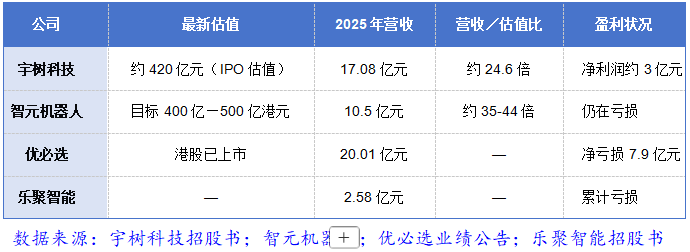
Zhiyuan's revenue‑to‑valuation ratio is significantly higher than Yushu's, meaning the capital market is paying a higher premium for its "future growth potential." Where does this premium come from? The answer may lie in Deng Taihua's "XYZ Curve" and "358 Blueprint"—investors are betting not on what Zhiyuan looks like today, but on what it could become in five or eight years.
V
Capital Surprise: Acquisition, JVs, and Industrial Loop
(I) Acquiring Shanghai New Materials for RMB 2.1 Billion
If the IPO is the "explicit line" of Zhiyuan's capital strategy, then the series of acquisitions and joint ventures orchestrated by Deng Taihua is a more discreet but equally crucial "implicit line."
In July 2025, Zhiyuan Robotics acquired 66.99% of the listed company Shanghai New Materials for about RMB 2.1 billion through a combination of block trades and tender offers. Upon completion, the actual controller of Shanghai New Materials became Deng Taihua, and Zhiyuan's core team, including Zhi Hui Jun, joined the board.
The move sparked widespread speculation. Shanghai New Materials hit three consecutive 20% daily limits after the announcement, with its share price rising from RMB 7.78 to RMB 13.45. In response to "backdoor listing" rumours, Zhiyuan stated that it was "not a backdoor listing, just an acquisition of a listed company." Though Zhiyuan said it had "no definitive Hong Kong listing plan" at the time, the strategic intent of securing a listed company — whether for capital platform building or industrial integration — is far‑reaching.
(II) Forming Joint Ventures with Over a Dozen Listed Companies
Acquisitions are not the end of Zhiyuan's capital strategy. Since 2025, Zhiyuan has intensively formed joint ventures with more than a dozen listed companies, including Lingyi iTech, Lens Technology, Wolong Electric, Dafeng Industry, Greenworks, Fuling Precision, and Dongyangguang, to jointly explore the blue‑ocean robotics market.
According to incomplete statistics from Robot Qianzhan, Zhiyuan has invested in 15 early‑stage projects, established at least 17 new companies through joint ventures, and more than 40 listed companies have partnered with Zhiyuan, including capital cooperation.
If we map Zhiyuan's business landscape along two dimensions, we can see its depth:
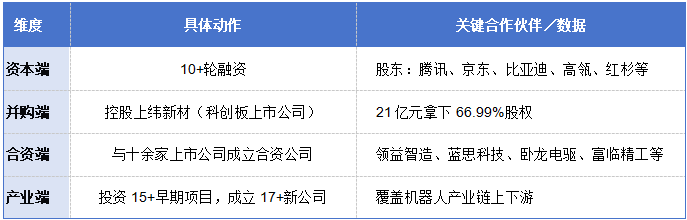
The underlying logic is clear: leverage capital to drive industry, and use industry to feed capital. Deng Taihua's experience at Huawei in building the Kunpeng and Ascend ecosystems is now being replicated in a different form in the robotics industry—not building a single technology platform, but building a dual‑track ecosystem of "capital+industry."
The "Second Competition" in Humanoid Robotics
In 2026, the competitive theme in the humanoid robotics industry has fundamentally shifted.
When Zhi Hui Jun declared the arrival of the "First Year of Deployment" at the HEIS Annual Conference, he said: "We have already deployed applications in eight typical scenarios, including entertainment/commercial performance, industrial manufacturing, logistics sorting, and security patrols. Only real‑world scenarios are the most effective way to validate reliability and iterate the system."
When Deng Taihua announced the "358 Blueprint" at the Partner Conference, he said: "Zhiyuan is one of the few embodied‑intelligence manufacturers to achieve mass production, and it is the fastest and largest in terms of volume."
For Zhiyuan, an IPO is never an end, but the starting line of a new race — from laboratory tech competition, to factory application competition, to capital‑market valuation competition. The long‑distance race for humanoid robots has only just begun, and Zhiyuan is already standing at the intersection of all three tracks.

 Official WeChat
 Official WeChat
